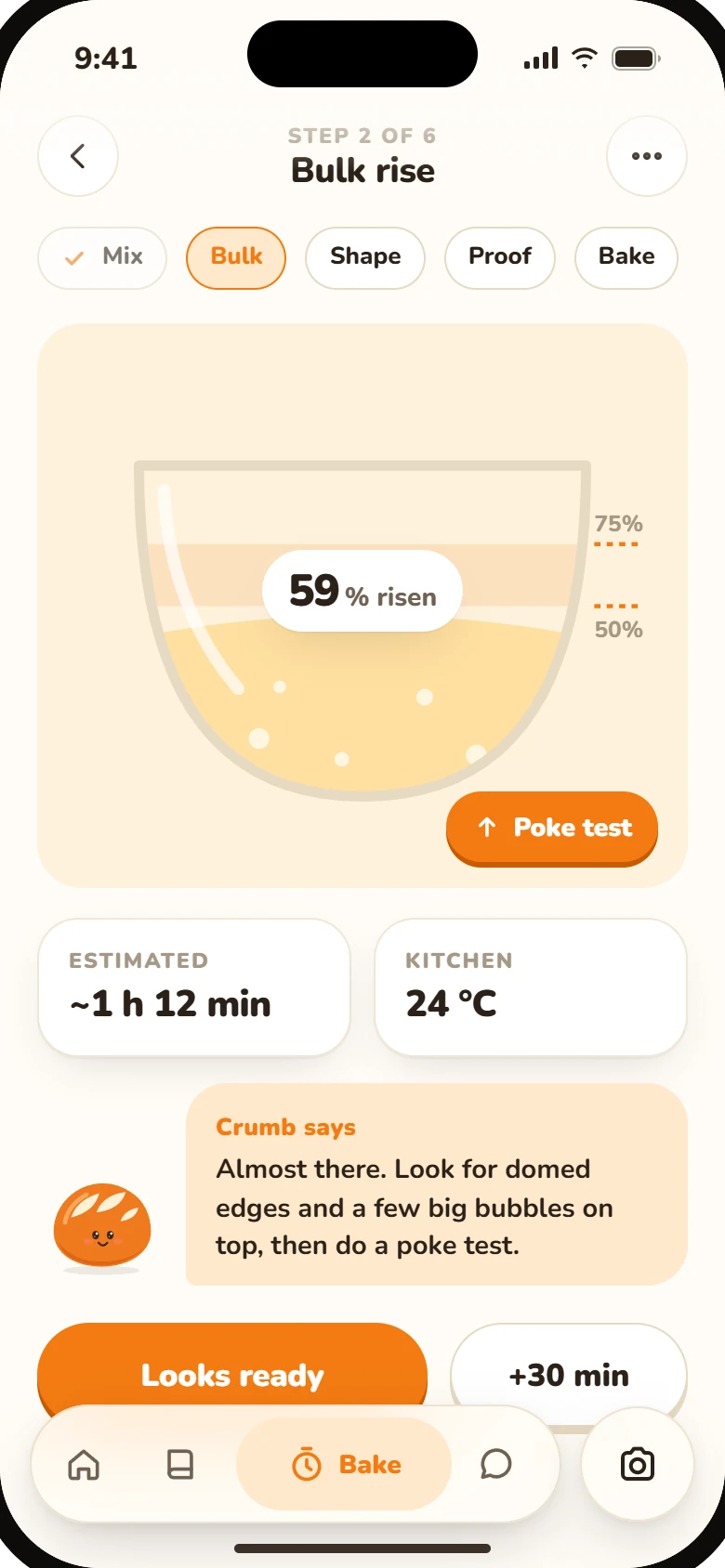
What bulk fermentation is
Bulk fermentation is the first rise of a sourdough loaf. It starts the moment your starter goes into the dough and ends when you divide and shape it. During bulk, the wild yeast in your starter makes gas that inflates the dough, and the bacteria make the acids that give sourdough its flavour. It is also when you build strength with stretch and folds.
Most of what makes a loaf open and light, or dense and gummy, is decided here. Under-fermented dough bakes tight and heavy. Over-fermented dough goes slack and spreads. The goal of the chart above is to give you a sensible window so you can start watching at the right time.
How to read the chart
Find your dough temperature in the left column. The highlighted row is the closest to the temperature you entered. Each column shows roughly how long the dough takes to grow by that much: a 50% rise means one and a half times its starting size, and a 100% rise means double.
The chart changes with your inputs. More starter shortens every time, a stiffer dough lengthens it, and a sluggish starter can add hours. If your bakes are always slower than the chart, choose a weaker starter strength and the times will follow your kitchen.
| Dough temperature | What to expect |
|---|---|
| Below 68°F (20°C) | Slow and steady. Leave plenty of time, and expect a tangier loaf. |
| 70 to 74°F (21 to 23°C) | Relaxed and forgiving. Easy to fit around a day at home. |
| 75 to 78°F (24 to 26°C) | The range many bakers aim for. Bulk fits in an afternoon. |
| Above 80°F (27°C) | Fast. Check early and often; the window between ready and too far is short. |
Why dough temperature matters most
Yeast and bacteria speed up as they warm. A good rule of thumb, and the one this calculator uses, is that fermentation runs about twice as fast for every 18°F (10°C) warmer. A few degrees therefore make a real difference: the same dough can need an extra hour or two on a cool day.
Take the temperature of the dough, not the room. Water temperature is the easiest thing to adjust: use warmer water on a cold day and cooler water on a hot one. A probe thermometer pushed into the middle of the dough right after mixing is all you need.
How to know when bulk fermentation is done
The clock gets you close. These signs tell you when to stop:
- Volume. The dough has grown by the amount you were aiming for. A straight-sided container with a mark at the starting level makes this easy to judge.
- Domed edges. The surface curves up where it meets the container instead of sitting flat.
- Bubbles. You can see bubbles on the top and along the sides, and a few large ones.
- Jiggle. A gentle shake of the container makes the dough wobble as one airy mass.
- Feel. The dough feels light and smooth, and it releases from the sides cleanly.
Many bakers end bulk a little earlier when the dough is warm, because fermentation keeps going during shaping and the final proof. When the dough is cool, it can usually go further before shaping.
Bulk fermentation versus proofing
Both are rises, but they happen at different times. Bulk fermentation is the long first rise of the whole batch of dough. Proofing is the final, shorter rise after the dough has been shaped into a loaf, often done overnight in the fridge. Bulk does most of the work; the proof finishes it.
Plan the two together. If you want to bake at a certain time, the sourdough schedule planner works backward from that time and places bulk, shaping and the cold proof for you.
Keeping the temperature steady
- An oven with only the light on is usually a few degrees warmer than the room. Check it with a thermometer first.
- On hot days, mix with cool water and keep the dough away from sunny windows and appliances.
- A small cooler with a jar of warm water inside makes a cheap, steady proofing box.
- Smaller batches change temperature faster than large ones.