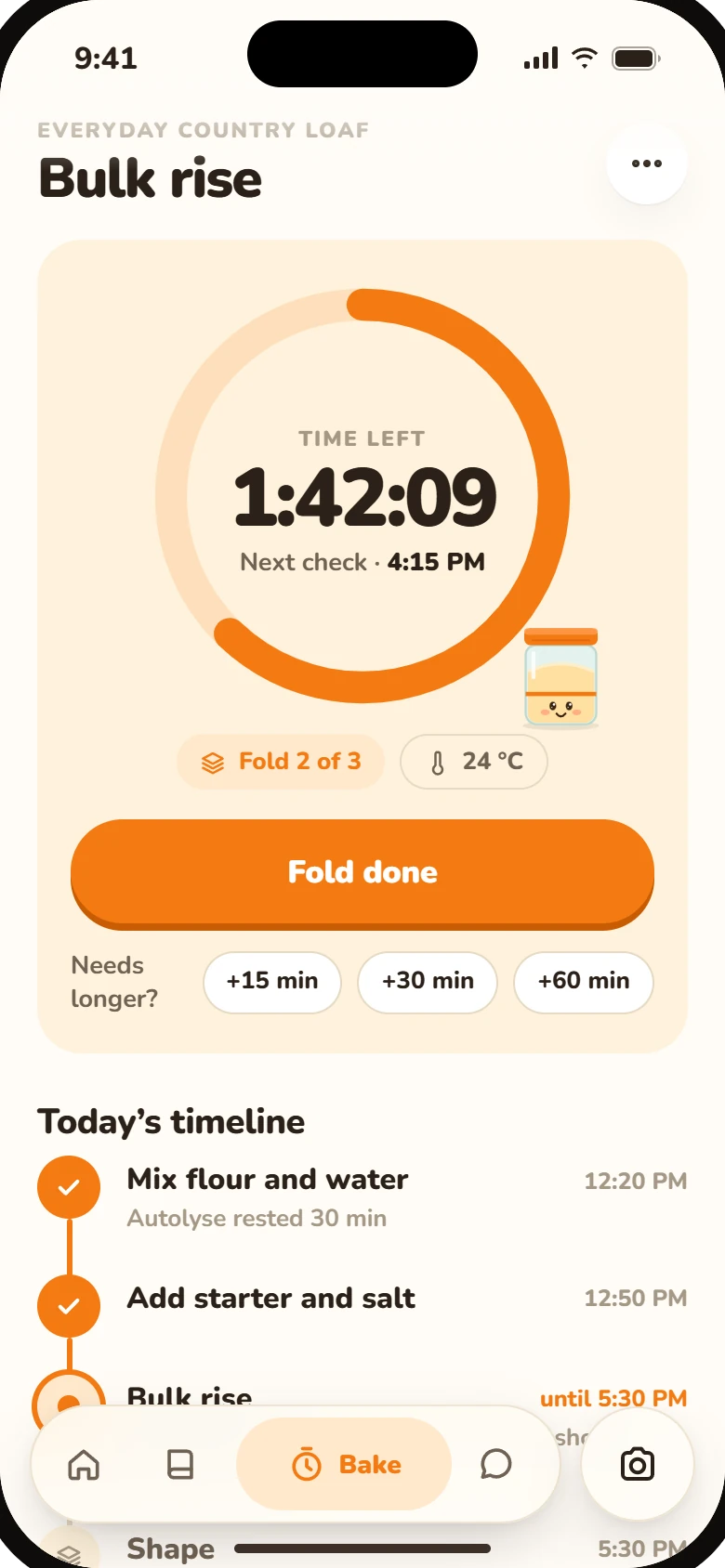
How the planner works
A sourdough bake is a chain of steps, each waiting on the one before it. If you know roughly how long each step takes, you can start from the end, the moment you want bread, and count backward. That is all this planner does, but it saves a lot of scribbled arithmetic and catches steps that would land at 3 a.m.
The default timings come from Zymo's Everyday country loaf: 45 minutes to mix and rest, about 4 hours of bulk fermentation with three sets of stretch and folds, 30 minutes to shape, an overnight cold proof and 45 minutes in the oven. Change any of them to suit your recipe and kitchen.
Three sourdough schedules that work
Weekend loaf, fresh for Sunday lunch
| When | Step |
|---|---|
| Saturday 9:00 AM | Feed your starter |
| Saturday 3:00 PM | Mix flour and water, then add starter and salt |
| Saturday 3:45 PM | Bulk fermentation, folds at 4:15, 4:45 and 5:15 |
| Saturday 7:45 PM | Shape |
| Saturday 8:15 PM | Into the fridge overnight |
| Sunday 10:15 AM | Score and bake |
| Sunday 11:00 AM | Out of the oven |
Around a 9 to 5 job
| When | Step |
|---|---|
| Monday 7:30 AM | Feed your starter at a high ratio, such as 1:5:5, before work |
| Monday 5:30 PM | Mix after work |
| Monday 6:15 PM | Bulk fermentation, folds through the evening |
| Monday 10:15 PM | Shape, then into the fridge |
| Tuesday 6:45 PM | Score and bake after work |
| Tuesday 7:30 PM | Out of the oven |
The fridge does the waiting while you are at work. A high feeding ratio slows the starter so it peaks in the evening; the starter feeding calculator gives the grams.
Same-day loaf
| When | Step |
|---|---|
| 6:00 AM | Feed your starter at 1:1:1 |
| 10:00 AM | Mix |
| 10:45 AM | Bulk fermentation |
| 2:45 PM | Shape |
| 3:15 PM | Proof on the counter |
| 5:15 PM | Score and bake |
| 6:00 PM | Out of the oven |
Making the schedule fit your day
- The cold proof is your buffer. It can usually stretch or shrink by several hours, so use it to move the bake to a convenient time.
- The feeding ratio moves the start. A higher ratio lets you feed earlier and still have a starter at its peak when you mix.
- Temperature moves bulk. Warm kitchens shorten it and cool ones lengthen it. Check the bulk fermentation chart for your dough temperature before setting the bulk time.
- Let it cool. The crumb is still setting when the loaf comes out of the oven. Slicing it hot is a common cause of a gummy loaf, so plan at least an hour before you eat it.
When the dough does not follow the plan
It often will not, and that is fine. Times are estimates; the dough is the real signal. If bulk is slow, give it more time and shorten the cold proof to keep your bake time. If it is racing ahead, shape early and let the fridge slow everything down.