The short answer
Underproofed dough is dense, tight and a bit gummy, and often has a few large tunnels under the crust. Overproofed dough is slack, flat and sour, and bakes into a loaf that spreads and has a weak, uneven crumb. Both come from the same cause, which is baking at the wrong point in the fermentation. The fix is almost always about dough temperature, starter strength and how long bulk ran.
A poke that springs back at once says underproofed. A poke that stays dented and does not move says overproofed. A slow, partial spring back says ready. The bulk fermentation chart gives you the time to start checking for your dough temperature and starter, and the rest of this guide covers how to read the dough once you do.
Signs at a glance
No single sign is reliable alone. Use two or three together. The table lists what each stage looks like, from the dough through to the cut loaf.
| Sign | Underproofed | Just right | Overproofed |
|---|---|---|---|
| Dough feel | Tight, firm, dense | Airy, jiggly, holds its shape | Slack, sticky, flows when scraped |
| Surface | Smooth, few bubbles | Domed, some bubbles | Large bubbles, wrinkled, may be sunken |
| Poke test | Springs back fast and fully | Springs back slowly, leaves a small dent | Dent stays or the dough sinks |
| Smell | Flat, floury | Mild, yeasty, a little sour | Sharp, boozy or vinegary |
| Oven spring | Bursts along one side or the score | Even lift, open score | Little lift, spreads sideways |
| Crumb | Dense, tight, with a few big tunnels | Open, even, glossy | Small, uneven holes, a gummy or collapsed band under the crust |
| Flavour | Bland, doughy | Balanced | Very sour, sometimes bitter |
Underproofed loaves often have a pale, thick crust and a gummy streak low in the crumb. Overproofed loaves often have a thin crust that looks pale where the loaf spread.
The poke test and when it misleads
Flour a finger and press about a centimetre into the dough. Watch the dent for a few seconds. A dent that fills back in under a second means the dough is underproofed and still has plenty of strength. A dent that fills slowly and leaves a small mark means it is ready. A dent that does not move at all means the dough has little gas holding and little strength left.
The test misleads in a few common cases. A cold dough from the fridge springs back slowly because it is cold and firm, not because it is ready. A high hydration dough, around 80% or more, feels slack at any stage, so it can look overproofed when it is not. See the hydration chart for how water changes the feel. A dough with weak gluten, from a short mix or too few folds, collapses early and reads as overproofed even when the rise is modest.
Poke the dough in the container, then check the volume against the mark you made at the start. A dough that is up 75% with a domed top and slow spring back is ready at the usual same-day target. If the numbers and the poke disagree, trust the volume and the smell over the poke.
Dough feel and volume cues
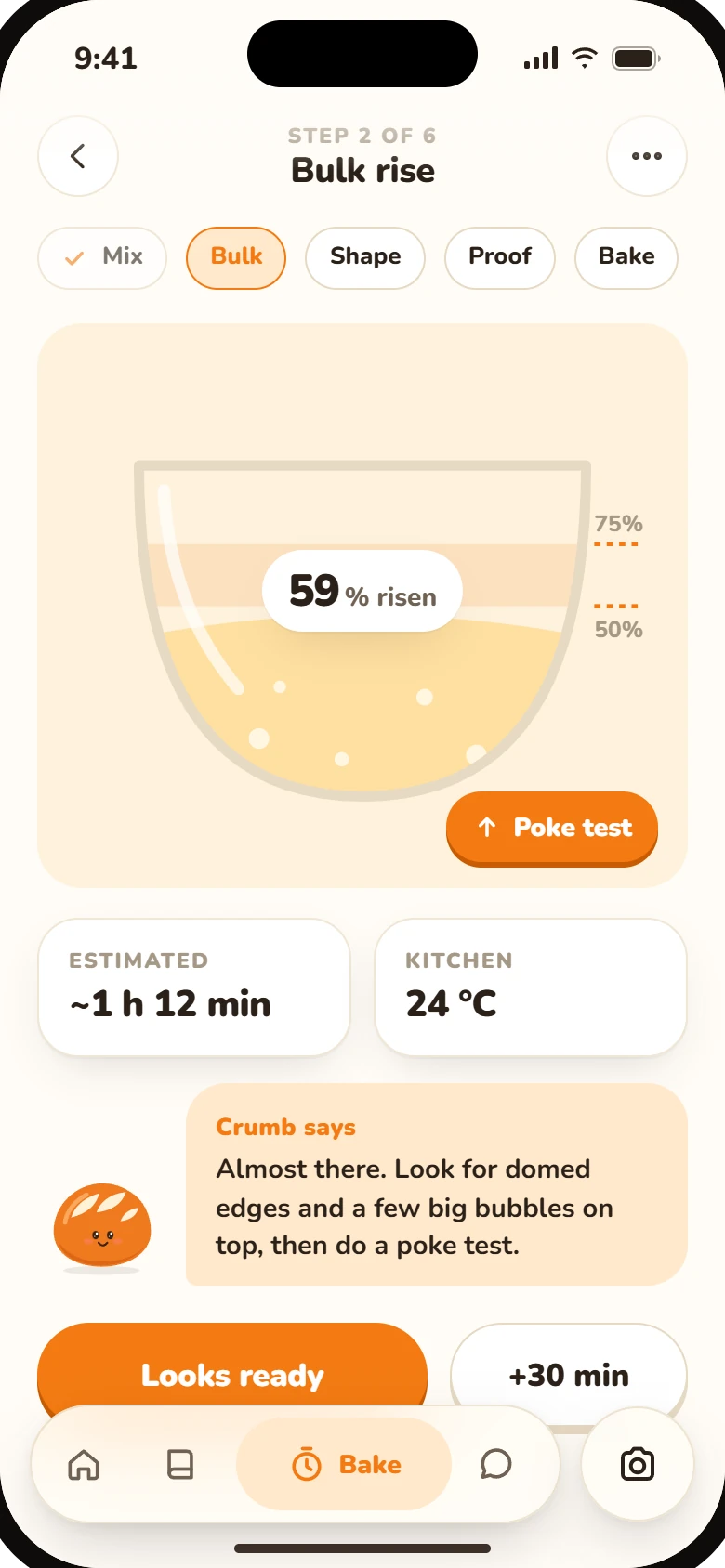
During bulk, mark the starting level on a straight-sided container. Underproofed dough looks flat on top and has risen less than half. Ready dough has grown by about 50 to 75% for a loaf you bake the same day, with a domed top, bubbles at the edges and a jiggle when you shake the container.
Overproofed dough has usually more than doubled. The dome sinks in the middle, big bubbles break the surface, and the dough smells sharp. It pulls apart in strings and sticks to your hands.
The final proof is shorter and harder to read. Shaped dough in a banneton should look puffy and feel marshmallow soft. At room temperature that stage is usually 1 to 2 hours when the dough started cold from the fridge, and less if the dough is warm. If the shaped loaf feels light, wobbles when you nudge the basket and the dent from a poke barely returns, bake it now.
Why dough temperature sets the window
Every timing in this guide depends on dough temperature after mixing, not the room. The planning model behind the bulk fermentation chart assumes fermentation runs twice as fast for every 18°F (10°C) of extra warmth. A dough that finishes bulk in 3 hours 15 minutes at 75°F (24°C) needs about 4 hours 15 minutes at 68°F (20°C) and about 2 hours 30 minutes at 82°F (28°C). The same recipe is on time in one kitchen and overproofed in another.
The table uses 20% starter, 75% hydration and 2% salt, and matches the bulk temperature chart guide. It shows the time to a 75% rise and to a 100% rise. Treat the 100% column as the latest point for a same-day loaf, not a goal.
| Dough °F | Dough °C | To a 75% rise | To a 100% rise |
|---|---|---|---|
| 68°F | 20°C | 4 h 15 min | 5 h 15 min |
| 72°F | 22°C | 3 h 40 min | 4 h 30 min |
| 75°F | 24°C | 3 h 15 min | 4 h |
| 78°F | 26°C | 2 h 55 min | 3 h 35 min |
| 82°F | 28°C | 2 h 30 min | 3 h 5 min |
Warm dough has a narrower window. At 82°F the gap between 75% and 100% is shorter than at 68°F, so ten minutes of distraction costs more.
Starter strength and hydration
More starter shortens the time. In the model, halving the starter doubles it. A starter at its peak is far stronger than one that peaked yesterday, so a weak starter often causes underproofing that looks like a cold kitchen. If the dough never reaches the chart time, check the starter with the starter not rising guide and feed it on a schedule. The starter feeding calculator gives the grams for any ratio.
The opposite problem is a large dose of starter in a warm kitchen. At 30% starter and 82°F, bulk can be done in about 2 hours, and a missed check means overproofed dough. Wholegrain and rye ferment faster than white flour, and wet dough feels slack sooner, so both change what the poke test tells you.
Reading the crumb
Cut the loaf after it cools, at least an hour. Cutting hot bread makes any crumb look gummy.
A tight, dense crumb with a thick gummy band near the base and a few large holes under the top crust points to underproofing. The dough had too little gas, so the oven pushed all the gas into one weak spot. Give the next bulk more time or a warmer spot.
Many small, uneven holes with thick walls, a collapsed top and a flat shape point to overproofing. A pale, sour loaf that spread sideways in the pot is the usual result. Shorten the next bulk or cool the dough.
A crumb that is open, glossy and fairly even with a few larger holes is the target. A mostly even crumb with a few big holes in the same spot is often a shaping issue and not a proofing one.
Fridge cases
The fridge slows fermentation but does not stop it. A large dough keeps rising for hours after it goes in, and a loaf that spends too long in the fridge can overproof there. Signs are a dough that more than doubled, a sharp smell and a flat top.
For a cold bulk, stop the room-temperature rise at 25 to 40% and chill for 8 to 14 hours. The fridge overnight bulk guide has the table. For a shaped loaf in the fridge, a shorter or cooler bulk first leaves room for the cold hours. A weak starter or a cold dough lets you go longer, and a warm dough with a strong starter needs less.
A cold final proof that still overferments usually has one of three causes. The dough went in too warm, the fridge runs at 42°F (6°C) or above, or the loaf stayed in too long. Use a fridge thermometer and plan the stay with the sourdough schedule planner.
What to do with dough that already went too far
Overproofed dough still bakes into good food. Gently degas it, reshape it into a tight ball and give it a short rest of 20 to 30 minutes. Reshaping squeezes out some gas and rebuilds the surface, and it works once. Bake it in a loaf pan so it cannot spread. If it is very slack, press it into a pan as focaccia with plenty of olive oil, or roll it thin for flatbread or pizza. A hot oven and a short bake suit all three.
If you do nothing and bake it as it is, expect a flatter loaf with less spring and a sour taste. It is still edible and good toasted.
For underproofed dough, the answer is more time in a warmer spot. Cover it and give it 30 minutes at a time, poking between each. An oven with only the light on is a common warm spot, so check it with a thermometer. Do not reshape underproofed dough, because the gluten needs time and not handling. If you must bake it now, score deeper to let the gas out and expect a tighter crumb.
Next bake, take a note of dough temperature, starter percentage and the actual bulk time. Two or three of those records tell you more about your kitchen than any table.
Checking the loaf with a crumb scan
After you cut the loaf, a photo of the crumb gives you a record to compare with the next bake. In Zymo, the Crumb loaf scan reads a photo and reports crumb openness, crust colour, oven spring, evenness and moisture, so you can see which of those moved after you changed the bulk time or the dough temperature. It is a check on the finished loaf, not a replacement for the poke test during the bake. Scans need an internet connection and Zymo is not on the stores yet, so the app is on a waitlist for now.
Frequently asked questions
How can I tell if my sourdough is overproofed or underproofed?
Poke the dough. A dent that springs back fast and fully means underproofed. A dent that stays or the dough sinking means overproofed. A slow, partial spring back means ready. Confirm with the volume against your starting mark, which is 50 to 75% for a same-day bake.
Can I save overproofed sourdough dough?
Yes. Degas it gently, reshape it into a tight ball, rest it 20 to 30 minutes and bake it in a loaf pan. Very slack dough also works as focaccia, flatbread or pizza.
What does an underproofed sourdough crumb look like?
It is dense and tight, with a gummy band near the base and a few large tunnels under the top crust. The dough had too little gas, so it burst in the oven. Give the next bulk more time or a warmer spot.
How long does it take for sourdough to overproof?
It depends on dough temperature and starter. With 20% starter, a 75% rise takes about 3 hours 15 minutes at 75°F (24°C) and about 4 hours 15 minutes at 68°F (20°C). Doughs past a 100% rise are at risk. Use the bulk fermentation chart for your numbers.
Can sourdough overproof in the fridge?
Yes. The dough keeps fermenting for hours after it goes in. Chill a cold bulk at a 25 to 40% rise and keep the stay to 8 to 14 hours. A warm fridge or a strong starter shortens the safe time.
Why is my sourdough dense even though it rose a lot?
Check the starter and the bake, not only the rise. A weak starter can leave dough that grows a little and is dense. A dough that was overproofed can also bake dense after it collapses in the oven. Cut the loaf cool and compare it with the table above.